

A client rang me in March because a customer had asked whether his business was “actually Kenyan”. He had a .com, a Nairobi office, a KRA PIN and eight staff. What he did not have was anything in his web address that said Kenya.
That is the whole argument in one phone call, and it cuts both ways. I have also watched a Kenyan exporter buy a .co.ke and then spend two years explaining to buyers in Dubai that yes, they ship there.
So this is the .co.ke vs .com decision laid out properly: what each extension is, what Google does with it, what it costs over five years, and the expiry rule that catches people out.
The short answer on .co.ke vs .com
If most of your customers are in Kenya, lead with .co.ke and use .com defensively if it is available. If most of your customers are outside Kenya, lead with .com and keep the .co.ke for the local office.
That is the .co.ke vs .com answer in one line. Everything below is the reasoning, plus the cases where the simple rule fails.
The one thing I would not do in the .co.ke vs .com decision is agonise for a fortnight. A domain is a rental, not a marriage, and a business that launches on shopname.co.ke this week beats one still choosing an extension in December.
What the two extensions actually are
Start with what each side of .co.ke vs .com actually is. A .co.ke is a country-code domain for Kenya, run by KeNIC, the non-profit licensed by the Communications Authority. You do not buy it from KeNIC — you buy it from an accredited registrar, which files the record into the registry database on your behalf.
Under .ke there are several second-level domains, and they are not interchangeable: .co.ke for commercial, .or.ke for NGOs, .ac.ke and .sc.ke for schools and colleges, .go.ke for government, .ne.ke for network operators, plus .me.ke, .info.ke and .mobi.ke. There is also a direct .ke, which we sell at Ksh 3,399 a year and which most Kenyan businesses do not need.
The other half of .co.ke vs .com is simpler. A .com is a generic domain run by Verisign under ICANN agreements, and anyone anywhere can register one with no local presence. That openness is the point of it, and it is also why the good names have been gone since roughly 2005.
One warning that costs real money. .co is not .co.ke — it is Colombia’s country code, and Google treats it as generic because the world uses it that way. A customer who drops the .ke from your address lands on a completely different business, or on nothing.
What Google does with each extension
This is where most of the internet’s advice about .co.ke vs .com gets vague, so here is what Google actually documents.
Google’s guidance on multi-regional sites says country-code domains are “tied to a specific country” and therefore provide “a strong signal to both users and search engines that your site is explicitly intended for a certain country”. For generic domains like .com, it points owners at locale-specific URLs and hreflang to indicate country focus instead.
Two honest caveats on .co.ke vs .com. First, that is a relevance signal, not a ranking bonus: a thin .co.ke still loses to a good .com with Kenyan content, links and a Google Business Profile. Second, the signal is a two-way street. The same country code that helps you in Nairobi quietly tells Google your site is not the one for a buyer in Kigali.
What actually moves rankings is the boring list: content that answers the query, a site that loads, local citations with a consistent address and phone, and links from other Kenyan sites. The extension decides which country you are competing in, not whether you win there.
Five-year cost of .co.ke vs .com
The .co.ke vs .com prices below are from our own store, checked on 18 November 2026. They are what a customer is billed, not a promotional headline.
| .co.ke | .com | |
|---|---|---|
| First year | Ksh 999 | Ksh 2,399 |
| Renewal, every year after | Ksh 1,500 | Ksh 2,500 |
| Transfer in | Ksh 1,500 | Ksh 2,500 |
| Five-year total | Ksh 6,999 | Ksh 12,399 |
| Grace period after expiry | none listed | 30 days |
The .co.ke vs .com gap is Ksh 5,400 over five years, which is roughly a year of shared hosting. That is the argument for .co.ke that survives every debate about prestige.
On .co.ke vs .com, compare renewals rather than first years, because that is where Kenyan registrars differ most. Truehost renews .co.ke at Ksh 1,500, HostPinnacle at Ksh 1,200, and some hosts quote a renewal only after you have paid the first year. The domain prices page lists all 33 extensions we sell with the renewal beside each one, and the 2026 price table compares the providers.
There is also a bundle effect worth knowing before you choose. Every annual shared plan includes a .co.ke in the first year, so the marginal cost of the Kenyan extension on hosting you were buying anyway is zero for twelve months. The free .co.ke guide explains what that offer does and does not cover.
The expiry difference nobody mentions
This is the part of .co.ke vs .com that actually decides the question for some businesses, and almost nobody raises it at the counter.
A .com expires and then sits in a grace period, which our store lists as 30 days — the clearest .co.ke vs .com difference in the registry rules. After that comes a redemption window where the registrar can usually restore the name for a fee, and only then does it return to the open market. Miss the renewal email and you still have weeks to fix it.
A .co.ke, as our store lists it, has no grace period. The term lapses, the name stops resolving, and recovery means a penalty plus the renewal if the registry has not released it yet. In practice a registrar may keep the site alive briefly while chasing the invoice, but you should not plan around that.
So if the domain is doing something critical — a shop taking M-Pesa orders, an email address on printed invoices — .co.ke vs .com stops being a branding argument and becomes a risk one. The safer choice there is the extension with the cushion. That is an argument for .com in exactly the case where the brand is exposed, and it is why I tell clients to diarise the renewal 45 days out either way.
What Kenyan buyers read into the extension
On .co.ke vs .com I cannot give you a survey, so treat this as what I see rather than data.
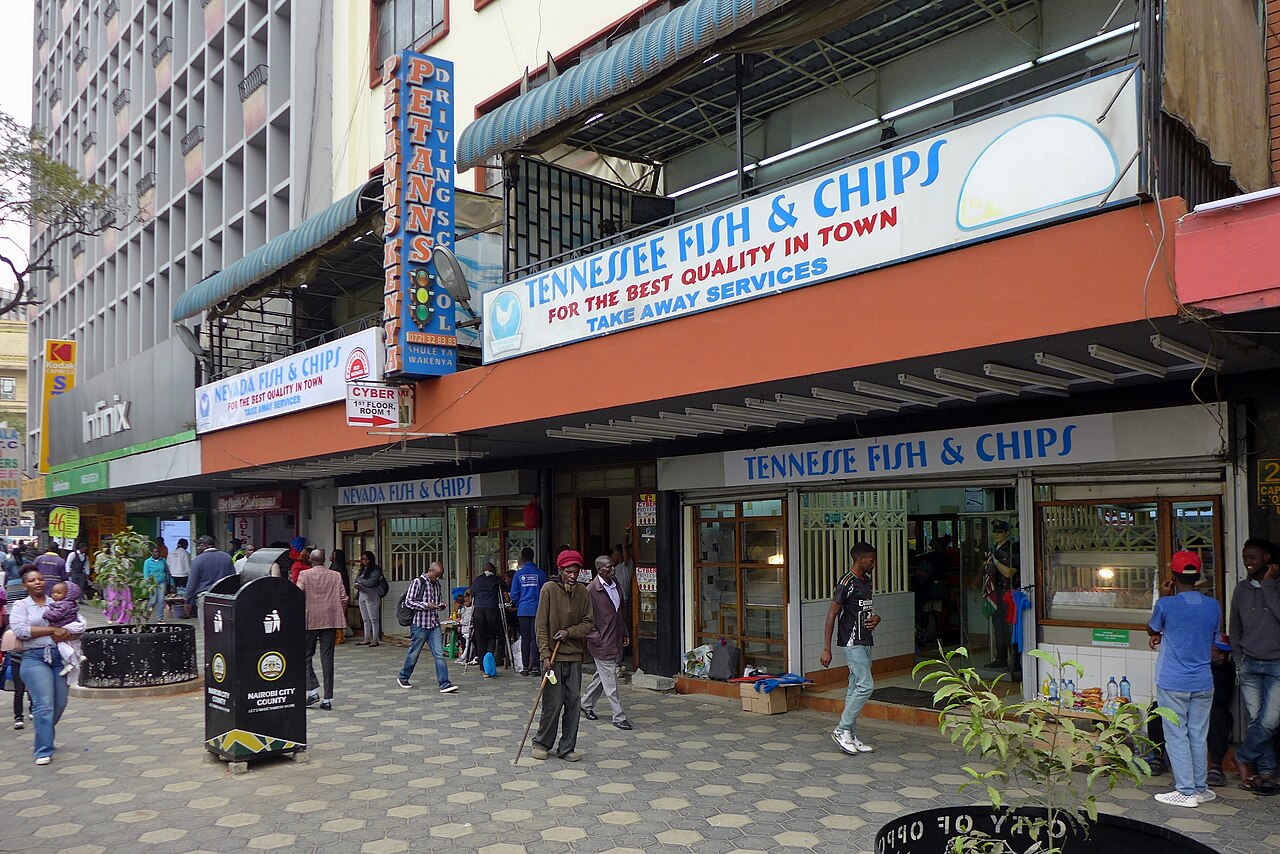
In the .co.ke vs .com comparison, a .co.ke does quiet work in three places. It answers the “is this a real Kenyan business?” question before it is asked. It matches the invoice a finance officer is checking against a KRA PIN. And it matches what a customer types when they half-remember your name, since .co.ke is what Kenyan businesses use.
None of that rescues a bad site, and a .com with a Kenyan address, a +254 number and shilling prices reads as Kenyan too. The extension is one signal among five, and it is the cheapest of the five to get right.
When .com should lead
Three cases where .com wins the .co.ke vs .com argument, and they are legitimate rather than vanity.

You sell outside Kenya. Exporters, tour operators selling to European agents, SaaS products, anyone invoicing in dollars. A .com is neutral and travels; a .co.ke asks a foreign buyer to work out where you are.
You expect investors, partners or acquirers from abroad. Some corporates still read a country code as “small local vendor”, fairly or not. If you are raising, the .com is the safer front door.
The name is a brand rather than a location. If you plan to be in three countries by 2028, buying the Kenyan extension first means buying again later.
Even then, keep the .co.ke. It costs Ksh 1,500 a year, it protects the name locally, and it is where your Kenyan customers will look for you.
The setup I recommend: one site, two domains
The .co.ke vs .com setup that works for most Kenyan SMEs in 2026 is a .co.ke as the primary address with a matching .com held defensively.
For .co.ke vs .com, pick one as canonical and 301 the other to it permanently. If Kenya is the market, the .co.ke is canonical and the .com redirects to it. Never run two sites with the same content — that is how a business ends up competing with itself for its own brand name.
Email should live on the primary domain only, and every mailbox should match it. If half your invoices come from @company.com and half from @company.co.ke, customers notice, and some spam filters score the mismatch. The business email versus Gmail comparison covers the mailbox side.
Then be consistent: Google Business Profile, WhatsApp business profile, invoices, signage, the lot. A .com on your shopfront and a .co.ke on your van is a small tax on trust you do not need to pay.
If you switch later, do it in this order
Changing your mind on .co.ke vs .com is not a rename, it is a migration, and the order matters more than the speed.
- Buy the new domain and keep the old one. Do not let the old registration lapse — that is how the redirects break.
- Set up the new site fully, with the same pages, before switching anything.
- 301 each old URL to its closest new URL, not everything to the homepage. Page-level redirects keep the rankings; a blanket redirect to home loses them.
- Update the canonical tags, the sitemap, and the Search Console property, then submit the new sitemap and request indexing.
- Keep the redirects live for at least a year, and update every profile, invoice template, email signature and printed item you can find.
- Watch Search Console for a month. Coverage errors after a migration are normal; a slow bleed of impressions is not.
If hosting is moving at the same time, do one job at a time. The hosting migration guide covers the DNS side, and doing both in the same week is how a site disappears for three days.
Three mistakes that cost more than the domain
Using a subdomain you rent. yourbusiness.co.ke.hostname.com is not a domain you own. Every link, listing and search history built on it belongs to the host, and moving later means starting again from zero.
Letting it lapse over a Ksh 1,500 invoice. Hosting, design and content are all replaceable. The name on your business cards, your email and your Google listings is not. This is the one line item where a missed payment is genuinely expensive.
Registering in someone else’s name. If the registrant field says the developer or the host, you do not own the domain, whatever the invoice says. The registration walkthrough shows which fields to check, and it takes one minute.
The short version
For .co.ke vs .com in 2026: Kenyan customers, Kenyan extension; foreign customers, global one; when in doubt, buy both and redirect one to the other.
On cost, .co.ke vs .com is Ksh 999 in year one and Ksh 1,500 a year after, against Ksh 2,399 and Ksh 2,500. The .com buys you a 30-day grace period and a neutral identity abroad; the .co.ke buys you a strong Kenya signal and a lower bill.
Whichever side of .co.ke vs .com you pick, put it in the business name, keep the renewal reminder 45 days out, and point it at hosting that is already paid for. Our shared plans include the .co.ke in year one and start at Ksh 1,999, which is the cheapest way to test the decision.
Frequently asked questions
Is .co.ke vs .com a ranking difference in Kenya? For ranking in Kenya, yes, mildly — Google documents the country code as a strong signal of intended country. It is a signal, not a bonus, so content and links still decide the result.
Can I rank in Kenya with a .com? Yes. Use Kenyan content, shilling prices, a Kenyan address and phone, a Google Business Profile, and links from Kenyan sites. Plenty of Kenyan businesses rank on .com for this reason.
Should I buy both .co.ke and .com? If the name matters, yes. Hold the second one, redirect it to the primary, and let it defend the name. Two live sites with the same content is the only version of this that hurts.
What happens if my .co.ke expires? It stops resolving and the store lists no grace period on it, so recovery depends on the registrar and the registry. Treat the expiry date as final, and set the reminder 45 days early.
Do I need a Kenyan company to register .co.ke? No. Individuals and businesses, local and international, can register through an accredited registrar. Restricted second-levels like .go.ke and .ac.ke are the exception and need proof of status.
Related reading
- How to register a .co.ke domain in Kenya — the step-by-step, including the registrant field that decides ownership.
- Free .co.ke domain with hosting — what the offer covers, and the renewal behind it.
- Domain prices in Kenya — all 33 extensions with first-year, transfer and renewal figures.
- Business email vs Gmail — why the address on your invoices should match the domain.
- Web hosting in Nairobi and hosting in Nakuru — what the hosting decision looks like in each city.